
Forrest County Arrest Records and Court Charges
A Forrest County arrest record is the law enforcement record of an arrest. It shows who was taken into custody, the agency that made the arrest, the date, and the booking details. The Forrest County Sheriff's Office, led by Sheriff Charlie Sims, handles most county arrests and the jail intake that follows. The agency has served the county since 1908. An arrest record on its own does not prove guilt. It records the accusation and the booking, nothing more. The formal court charges come later, after a prosecutor reviews what the arresting officers submit.
The court charge record is a different document. The court charges after arrest are decided by the District Attorney or the County Prosecuting Attorney, who files them with the court clerk and tracks them as the case moves forward. The booking side of an arrest, including the jail roster, stays with the Sheriff's Office, and the Forrest County inmate records page covers that roster in detail. The filed charges, along with pleas and the final outcome, become part of the criminal case file. For the full case file and sentencing, see the Forrest County criminal court records page.
The Forrest County Sheriff's Office describes its leadership and divisions on its agency about page.
The office that books an arrest is the first custodian of the arrest record that a court charge is later built on.
How to Find Forrest County Arrest Records and Charges
No single portal holds every Forrest County charge. The court that handles the case keeps the record. Felony charges run through Circuit Court and Mississippi Electronic Courts. City misdemeanor and traffic charges from Hattiesburg show up in the Hattiesburg Municipal Court search portal. Lower-level county charges sit with Justice Court. To read the charges filed in a case, start with the court that has jurisdiction, then open the case file. Booking detail, by contrast, stays with the jail roster.
- Open the court case search for the right court. Use Mississippi Electronic Courts for Circuit and County Court matters, or the Hattiesburg Municipal Court portal for city cases.
- Search by the defendant's name or, if you have it, the case number.
- Open the case and read the list of charges filed against the defendant.
- Check each charge for its statute code, severity level, and current status.
Charges can also be confirmed by phone or in person. Justice Court staff answer at (601) 544-3136, and the Hattiesburg Municipal Court takes case and fine questions at 601-545-4933. For arrest and incident reports held by law enforcement, the Sheriff's Office accepts public records requests by email at fcsorecords@co.forrest.ms.us. State-level lookups, covered further below, pick up where the local courts end.
How Charges Get Filed After an Arrest: Complaint, Information, and Indictment
An arrest does not file charges by itself. The charge record begins when a prosecutor files a formal charging document with the court. In Forrest County, District Attorney Lin Carter handles felony charges for the Twelfth Circuit District, which covers Forrest and Perry Counties. County Prosecuting Attorney Jack Denton handles many county-level cases. The type of document depends on how serious the offense is and which court hears the case.
| Complaint | Information | Indictment | |
|---|---|---|---|
| Filed By | Officer / Prosecutor | Prosecutor | Grand Jury |
| Common For | Misdemeanors | Many felonies | Serious felonies |
| Starts | The case | The case | The case |
A complaint or affidavit often starts a misdemeanor case in Municipal or Justice Court. Felonies usually move to a grand jury, which reviews the evidence and returns an indictment in Circuit Court. An information lets a prosecutor charge a felony directly when the defendant waives the grand jury. Each path opens a court case and creates the charge record the public can later read.
Note: The District Attorney files felony charges, while the County Prosecuting Attorney handles many lower-level county cases.
Charge Status and What It Means
Charges are not fixed once filed. As a case moves, a prosecutor can amend, reduce, add, or drop charges. A judge can dismiss a charge. The status field in a court record tells you where each charge stands at that moment. Reading it correctly matters, because an open charge and a dropped charge mean very different things.
| Status | What It Means |
|---|---|
| Pending | The charge is filed and the case is still active. No final outcome has been entered. |
| Amended / Reduced | The charge was changed, often to a lesser offense, through negotiation or new facts. |
| Dismissed | The court ended the charge without a conviction. It may be dismissed with or without conditions. |
| Nolle Prosequi | The prosecutor chose not to pursue the charge, which ends it without a conviction. |
Note: A dismissed or dropped charge stays visible in many court records unless it is later sealed or expunged through a separate court filing.
Charges vs. Convictions
Being charged is not the same as being convicted. A charge is an accusation. It means a prosecutor believes there is probable cause that a person committed an offense. A conviction is a finding of guilt, entered by a plea or a verdict, under a much higher standard of proof. A Forrest County arrest record or charge record can list serious offenses that never led to a conviction.
| Charge | Conviction | |
|---|---|---|
| Stage | Accusation | Verdict or plea |
| Burden of Proof | Probable cause | Beyond reasonable doubt |
| Public Record | Yes | Yes |
This distinction protects people. Many charges are dismissed, reduced, or end in acquittal. A record reader should never treat a filed charge as proof of guilt. The conviction, if any, appears in the case disposition, which the full criminal court record spells out.
Sealed vs. Expunged Charge Records
Some charge records leave public view after a case ends. Mississippi treats sealing and expunction as two different steps, and each has its own effect on what the public can find. The terms are easy to mix up, so the distinctions matter.
- Sealed record
- A record kept from general public view by law or court order, though limited users such as courts and law enforcement may still reach it.
- Expunged record
- A record removed from public access and treated as if the offense never occurred, with only narrow law-enforcement exceptions remaining.
- Eligibility in Mississippi
- Expunction runs through the court that handled the case and depends on the offense, prior record, completed sentence, payment of costs, and waiting periods.
Expunction of qualifying charges and convictions is governed by Miss. Code Ann. 99-19-71. A person petitions the court where the case was handled, which may be Municipal, Justice, County, or Circuit Court. Dismissed charges, pretrial diversion, and certain first-offender outcomes follow different rules, so the filing must match the statute.
Charge Codes and Severity Levels
Every charge ties back to a specific law. The court record lists the statute or city ordinance the charge rests on, often with a short code and a description. Mississippi sorts offenses by severity, and the level shapes which court hears the case and what penalty is possible.
- Felonies: serious offenses that route to Circuit Court and can carry state prison time.
- Misdemeanors: lower-level offenses handled in Justice or Municipal Court, punishable by fine and county jail.
- Ordinance violations: city code breaches charged in Hattiesburg Municipal Court.
One arrest can produce several separate charges. A single incident may list a felony count alongside related misdemeanors, each with its own code and status. The Sheriff's Office reports offense data through the national incident-based system on its crime statistics page.
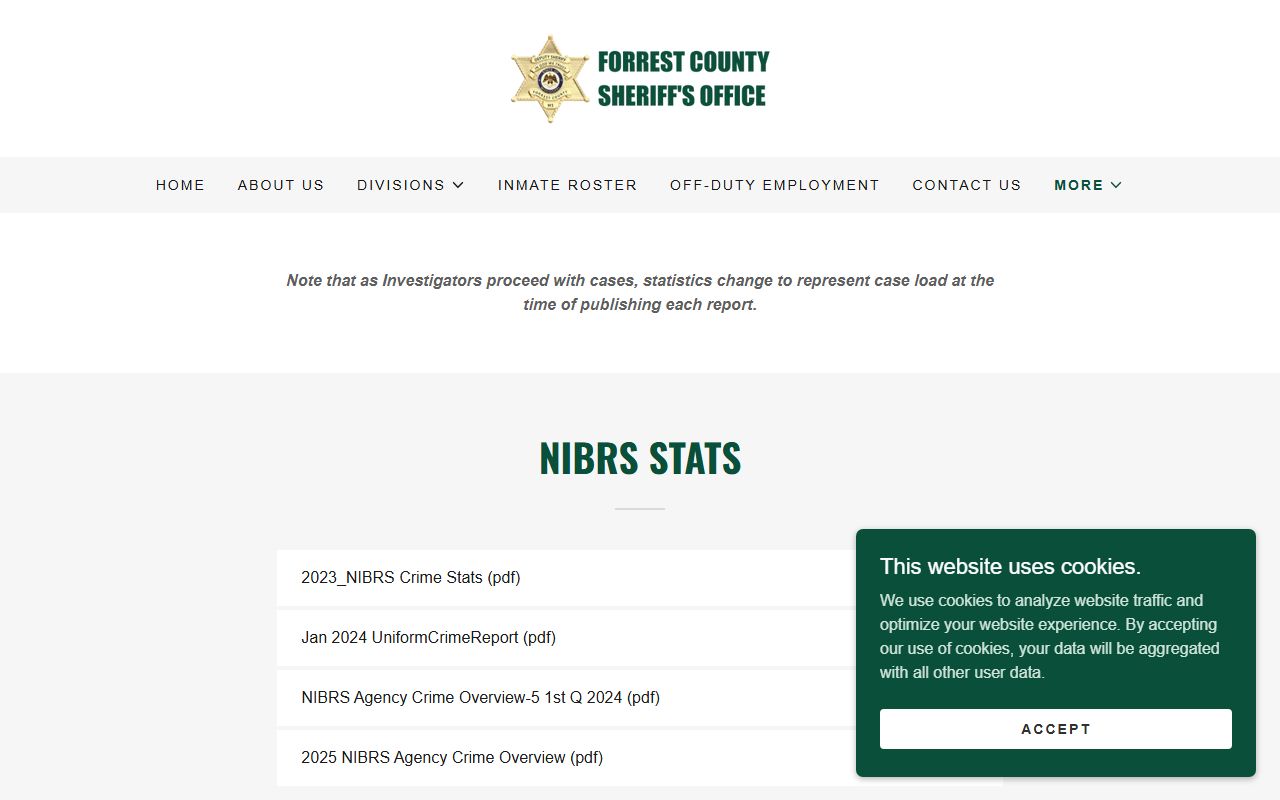
Those NIBRS offense categories mirror the kinds of charges that later appear in county arrest records and court charge files.
Statewide Charge and Criminal History Lookups
Some charges roll up into statewide systems. When a Forrest County felony ends in a state prison sentence, the person appears in the Mississippi Department of Corrections inmate search rather than the county jail roster. The MDOC system searches by name or by MDOC ID number. For convictions that require registration, the Mississippi Sex Offender Registry lists names, addresses, and charge information statewide.
Record questions for state custody go to the agency's records department contact page.
MDOC records staff handle requests the county jail roster cannot, since state inmates leave county custody. Mississippi does not offer a single public website that returns a full criminal history for any name. A complete charge and conviction history is pieced together from each court, the Sheriff's incident records, and the state systems above.
Note: County jail custody and state prison custody are tracked in different systems, so a name may appear in one and not the other.
Background Check Considerations
A casual record search is not the same as a formal background check. Employers, landlords, and licensing bodies that screen people must follow the federal Fair Credit Reporting Act. That law sets rules on consent, accuracy, and how a person can dispute a record. A quick name search through a court portal does not meet those standards.
Important: This site is not a consumer reporting agency under the Fair Credit Reporting Act, and its records cannot be used for employment, housing, credit, or other FCRA-regulated decisions.
Restricted Charge Records in Forrest County
Not every charge record is open to the public. Mississippi law shields some categories outright. Youth Court records involving children are confidential and are not part of any public charge search. Records that a court has sealed or expunged drop out of public view. Active investigations and certain law-enforcement files can also be withheld while a case is open.
- Juvenile charges: confidential under Miss. Code Ann. 43-21-261.
- Sealed or expunged charges: removed from public access by court order.
- Pending investigation records: may be exempt while a case stays open.
- Personal identifiers: Social Security and account numbers are redacted.
For arrest and incident reports the Sheriff's Office holds, the public can file a request by email to fcsorecords@co.forrest.ms.us. The Mississippi Public Records Act governs the process, and Miss. Code Ann. 25-61-7 lets agencies charge for the work. The Sheriff's posted fee schedule charges 15 cents per black-and-white page and 25 cents per color page. Search, review, and redaction are billed at actual cost. Records sent by email under 25 megabytes carry no charge, a USB drive or CD costs $10, and a flat $5 report fee may apply for involved parties such as victims or their representatives.