
Criminal Court Records in Forrest County
A criminal court record is the case file a court opens the moment a charge is filed. It is more than a single arrest entry. The file gathers every step the case takes, including the charges as filed, the plea entered, the motions argued, the hearings held, the verdict or plea, and the sentence. In Forrest County the Circuit Clerk keeps the felony docket, and that docket holds names and parties, pleas, indictments, lower-court records on appeal, and papers entered and referenced to the minute book. Lower courts keep their own criminal files. For the charges alone, see the Forrest County arrest records and charges page. For every other case type, the broader Forrest County court records page covers civil, family, and probate files.
Several courts hear criminal cases here, and the court depends on how serious the offense is. Circuit Court is the main trial court for state felonies and also hears appeals from the lower courts. Justice Court handles lower-level criminal matters where the punishment cannot go beyond a fine and time in the county jail. Hattiesburg Municipal Court handles city misdemeanor arrests, traffic citations, first appearances, and preliminary hearings for felony defendants. County Court and Youth Court handle youth matters, which stay confidential. Each court keeps its own record, so the same person can have files in more than one place.
How to Search Forrest County Criminal Court Records
No single portal covers every Forrest County criminal court record. Felony and county-level cases route through Circuit and County Court on Mississippi Electronic Courts, the statewide e-filing and access system known as MEC. Public access runs through Public Access to MEC, called PAMEC. The Circuit Clerk keeps the underlying docket at the Hattiesburg courthouse. For city cases, Hattiesburg Municipal Court holds its own records and offers a public computer in the lobby to view misdemeanor convictions.
The official MEC court information for the Twelfth Circuit District is a good place to confirm court contacts and access details. The MEC court information page for Forrest County lists the go-live dates and helpdesk contacts for the local Circuit and County Courts.
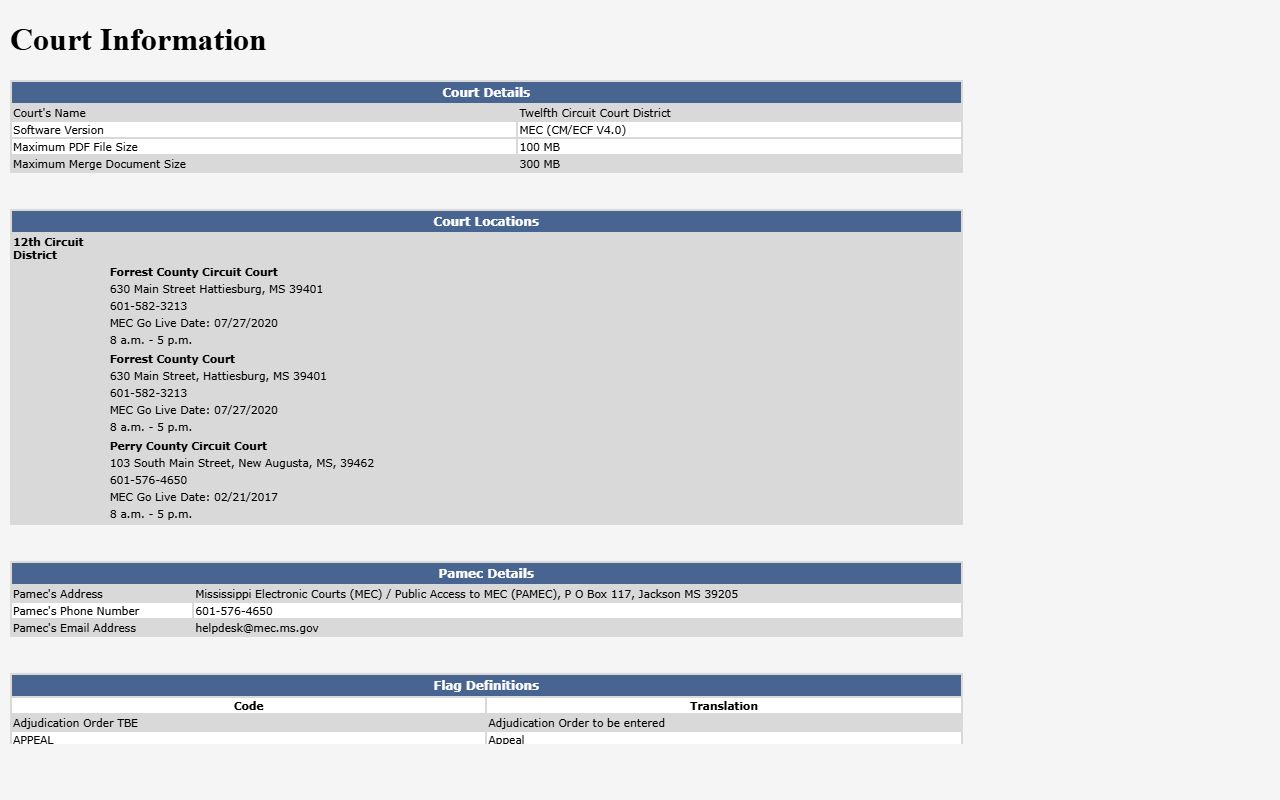
That page confirms the Forrest County Circuit Court and County Court joined Mississippi Electronic Courts in mid-2020, so most newer felony filings are tracked there. Use these steps to find a case file:
- Identify the court. Felonies and major cases sit in Circuit Court. County misdemeanors and small criminal matters sit in Justice Court. City tickets and misdemeanors sit in Hattiesburg Municipal Court.
- For Circuit and County Court cases, open Mississippi Electronic Courts and the PAMEC public access system, then search by defendant name or case number.
- Narrow the results by court, case type, and filing date so the right defendant and charge appear.
- Open the case to read the docket, the listed charges, the plea, and the final disposition or sentence.
- Request a certified copy from the Circuit Clerk if you need a court-accepted version of the record.
State-level searches add depth. Mississippi Electronic Courts can hold filings, indictments, and orders, though full document access may need a PAMEC account or a fee. For someone serving a state prison term after a felony conviction, the Mississippi Department of Corrections inmate search is the better tool. The county jail roster shows recent bookings and pretrial custody rather than closed case outcomes.
Stages of a Criminal Case
A criminal case moves in a clear order, and each step leaves a mark in the record. The file starts when charges are filed. In felony matters the District Attorney for the Twelfth Circuit District takes the case to a grand jury, which can return an indictment. Lower-level matters begin with an affidavit or a complaint. From there the case is set for arraignment, then pretrial work, then a plea or trial, and finally a disposition and any sentence. Reading the docket in order tells you where a case stands.
Case flow: Charges Filed › Arraignment › Pretrial / Motions › Plea or Trial › Disposition › Sentencing
| Stage | What Happens |
|---|---|
| Arraignment | The court reads the charges, advises the defendant of rights, and takes a first plea such as guilty or not guilty. Bond and counsel can be addressed here. |
| Pretrial / Motions | Lawyers file and argue motions, exchange evidence, and ask for rulings. Hearing dates, continuances, and bond changes appear in the docket. |
| Plea or Trial | The case ends in a negotiated plea or goes to trial before a judge or jury. The record notes the plea agreement or the verdict. |
| Sentencing | After a guilty plea or guilty verdict, the judge imposes a sentence. The record lists jail or prison time, probation, fines, and court costs. |
The District Attorney, Lin Carter, handles felony prosecution at the circuit level, including indictments and plea talks, and can be reached at (601) 545-1551. County Prosecuting Attorney Jack Denton works county-level cases and can be reached at (601) 544-4333 or jdenton@forrestcountyms.us. A defendant who cannot afford a lawyer may use the Public Defender at (601) 545-6122.
What a Forrest County Criminal Court Record Shows
A criminal court record is built field by field as the case moves. The Circuit Clerk docket holds names and parties, pleas, indictments, and papers referenced to the minute book. A full case file adds motions, hearing dates, orders, fines, costs, and any appeal. The table below breaks down the main fields you will see when you open a Forrest County criminal court record.
| Field | What It Shows |
|---|---|
| Case Number | The unique number the court assigns the case. Format varies by court and by the MEC or local docket system. |
| Defendant | The person charged, listed by name and often by date of birth or other identifiers used to match the right party. |
| Charges | The offenses as filed, with the alleged statute or ordinance and the level, such as felony or misdemeanor. |
| Plea | The defendant's formal answer, such as guilty, not guilty, or no contest, and the date it was entered. |
| Disposition | The final outcome for each charge, such as a conviction, a dismissal, an acquittal, or a diversion. |
| Sentence | The punishment after a conviction, including jail or prison time, probation, fines, restitution, and costs. |
Other entries round out the file. Bond and hold status can appear, along with hearing and motion dates from the court calendar. Felony files often carry the indictment text and references to lower-court records on appeal. Some details are redacted, including Social Security numbers, minor names, and other private data the law protects.
Charges vs. Convictions
Being charged is not the same as being convicted. A charge is an accusation that a crime occurred. A conviction is a finding of guilt by plea or verdict. A Forrest County criminal court record can show charges that were later dropped, dismissed, reduced, or that ended in acquittal at trial. Reading only the charge line can mislead you. Always read the disposition before drawing any conclusion about a case. The two columns below show why the distinction matters.
| Charge | Conviction | |
|---|---|---|
| Stage | Accusation | Verdict or plea |
| Burden of Proof | Probable cause | Beyond reasonable doubt |
| Public Record | Yes | Yes |
Reading Dispositions and Sentences
The disposition is the final outcome of a charge, and it carries the most weight in any criminal court record. A guilty finding or guilty plea means a conviction. Not guilty means an acquittal. A dismissal ends the charge without a conviction. A plea of no contest, sometimes called nolo, means the defendant does not fight the charge but does not admit guilt. Some cases end in deferred adjudication or diversion, where charges can be dropped after a defendant meets set conditions.
The sentence sits right beside the disposition. After a conviction the judge can impose jail or prison time, probation, fines, restitution, and court costs. Justice Court punishments stay within a fine and county-jail time, while Circuit Court can impose state prison terms for felonies. A record may show a sentence as served, suspended, or running with probation. When a term, a charge code, or an abbreviation is unclear, the clerk of the court that handled the case can confirm what it means.
Note: A criminal court record without a clear disposition may still be open, so check the docket dates before treating the case as final.
Sealed vs. Expunged Records
Sealing and expunction both pull a record out of public view, but they work in different ways. A sealed record still exists and stays hidden from the general public, with limited access for certain officials. An expunged record is removed from public access and treated as if it never existed for most purposes. In Mississippi, expunction of a qualifying conviction runs through Miss. Code Ann. 99-19-71. The petition is filed in the court where the conviction occurred, so a felony case goes back to Circuit Court and a city case goes back to Municipal Court.
| Sealed | Expunged | |
|---|---|---|
| Visibility | Hidden from public | Destroyed / treated as never existed |
| Law Enforcement | Limited access | Very limited |
| Eligibility | Often youth-court files and records sealed by court order | Qualifying misdemeanors and certain felonies under Miss. Code Ann. 99-19-71 |
Eligibility for expunction depends on the offense type, the number of convictions, payment of fines and costs, and any waiting period. The petitioner identifies the case, the charge, the disposition, and the sentence-completion date, then files in the court of conviction. The court may require notice to the prosecutor and a hearing. If the order is granted, public agencies and clerks remove the eligible record from public access, though law enforcement may keep limited access under narrow exceptions.
Public Access to Criminal Court Records
Most Forrest County criminal court records are open to the public under the Mississippi Public Records Act. Court files are held by the clerk of the court that handled the case, so a request goes to the Circuit Clerk for felonies, the Justice Court Clerk for county matters, or Hattiesburg Municipal Court for city cases. Arrest and incident reports are kept by law enforcement rather than the court. The Forrest County Sheriff's Office runs a public-records policy and directs report requests to fcsorecords@co.forrest.ms.us.
The Sheriff's Office homepage lays out its records policy and the cost schedule for copies. Its Forrest County Sheriff's Office homepage links the public-records policy, the fee schedule, and the request forms in one place.
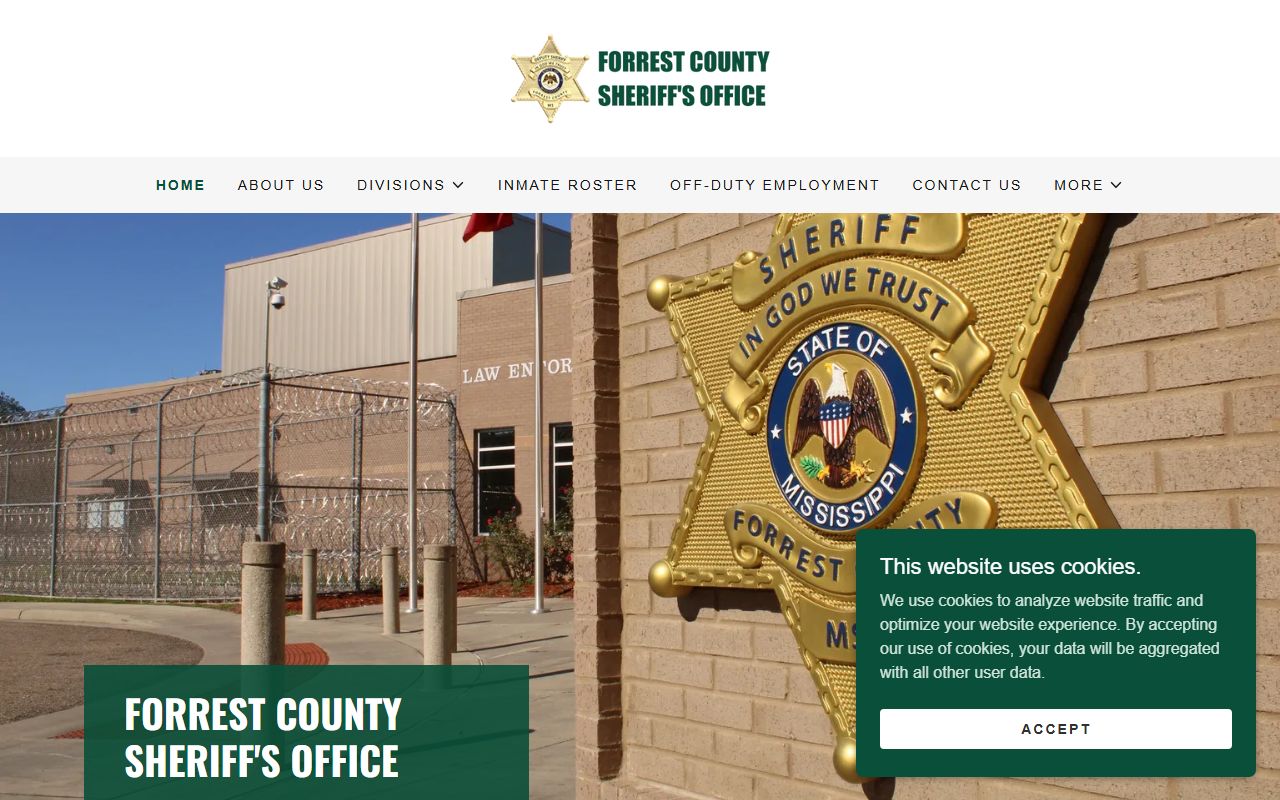
Those sheriff records cover the arrest and incident side of a case, while the court file covers the charges, plea, and sentence. Together they show the full picture of a Forrest County criminal court record. The statutes below set the legal framework for access.
Key Statutes:
Mississippi Code § 25-61-1 - Establishes the Mississippi Public Records Act and the policy that public records are open unless the law says otherwise.
Mississippi Code § 25-61-5 - Gives the public a right to inspect, copy, or reproduce public records under reasonable written procedures and listed exemptions.
Background Check Considerations
A casual lookup of Forrest County criminal court records is not the same as a formal background check. Employers, landlords, and licensing bodies that screen people must follow the federal Fair Credit Reporting Act. That law sets rules for accuracy, consent, and how a person can dispute an error. A quick search of a court docket carries no such protections and can miss sealed, expunged, or amended entries. For a hiring or tenancy decision, use a licensed screening service that follows the law.
Important: Forrest County Court Records is not a consumer reporting agency under the Fair Credit Reporting Act, and its information cannot be used for employment, tenant, credit, or other FCRA-regulated screening.
Restricted Criminal Court Records in Forrest County
Public access is broad but not absolute. Youth-court cases involving children are confidential under Miss. Code Ann. 43-21-261, and they can be sealed or unsealed only under Miss. Code Ann. 43-21-263. The public should not expect an online juvenile case search. A parent, attorney, or authorized person should contact the County and Youth Court office and be ready to show identification and proof of authority. Sealed and expunged records also drop out of ordinary public searches, and certain mental-health and commitment files stay restricted.
Law-enforcement records follow their own request path. To ask the Sheriff's Office for an incident or arrest report tied to a criminal case, use its records-request page. The Forrest County Sheriff's Office records request page directs completed forms to fcsorecords@co.forrest.ms.us and links the request and background-check forms.
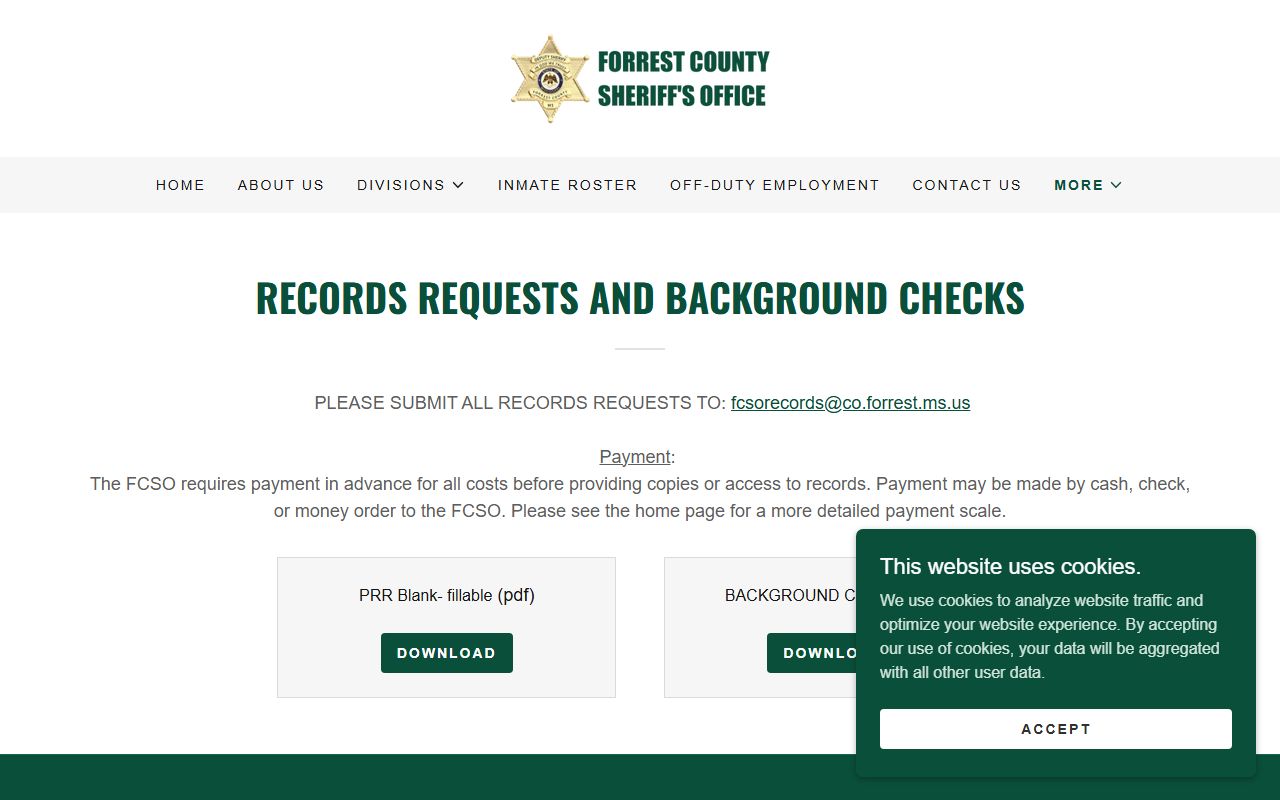
That request channel covers the arrest side, while restricted court files stay with the court that holds them. Open cases can also be limited while they are active, since not every motion or sealed filing is public. When a record does not appear in a search, contact the clerk of the court that handled the case to confirm whether it is confidential, sealed, or simply held offline.