
Probate Is a Chancery Court Matter
Mississippi does not run a separate probate court. In Forrest County, probate is a function of the Chancery Court. That court handles the legal steps that follow a death and the ongoing care of people the law calls wards. Estates, wills, and the appointment of an executor all start here. So do guardianships for minors and conservatorships for adults who cannot manage money or health choices. The Chancery Court also hears trust disputes, land and partition matters, adoptions, and involuntary mental or drug commitments. Each of these creates a case file that the Chancery Clerk keeps.
The Forrest County Chancery Court sits in the Paul B. Johnson Chancery Building in downtown Hattiesburg. Forrest County belongs to the Tenth Chancery District, which also covers Lamar, Marion, Pearl River, and Perry counties. Four chancellors serve the district: Chase Ford Morgan, Rhea H. Sheldon, Sheila Smallwood, and Chad Smith. A chancellor is the judge who hears probate and other equity cases. The Chancery Clerk, Lance Reid, creates and maintains a file for each chancery suit, keeps the dockets, and accounts for filing fees.
The county Chancery Clerk also runs an online records portal that supports land and case research. The lead-in image below comes from the Chancery Clerk records portal, the office's gateway for probate-related case and land-record lookups.
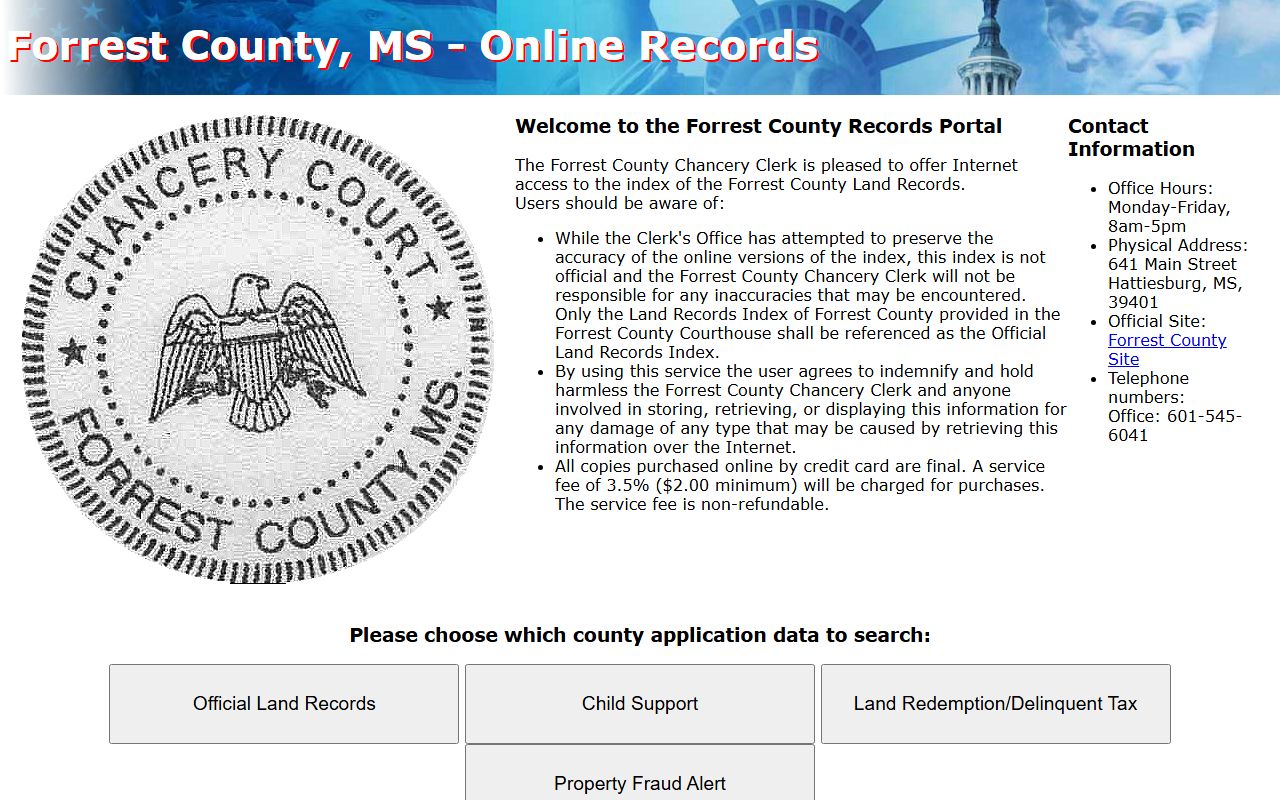
That portal explains that its online index is not the official record and that the courthouse index controls. For probate, it points you toward the right office and the Chancery Court case search rather than a download of full estate documents.
Probate Terms Defined
Probate filings use words that rarely come up in daily life. A quick glossary helps you read an estate or guardianship file and speak with clerk staff. These are the terms you will meet most often in a Forrest County Chancery Court matter.
- Testator
- The person who made the will. A testator decides who inherits and names someone to carry out those wishes.
- Executor
- The person named in a will to settle the estate, pay debts, and distribute property to heirs.
- Administrator
- The person the court appoints to settle an estate when there is no will, or when no executor can serve.
- Intestate
- Dying without a valid will. State law then decides who inherits the estate.
- Letters Testamentary
- The court order that gives an executor legal power to act for the estate.
- Inventory
- A filed list of the assets in an estate, used to track and account for property.
- Guardianship
- Court oversight of a minor or another person who needs someone to make personal or care decisions for them.
- Conservatorship
- Court oversight of the finances and property of an adult who cannot manage those affairs alone.
How to Search Forrest County Chancery Court
The main online tool for probate is the Chancery Court case search hosted by Delta Computer Systems. It lets you look up a case by party name, case number, filed date, final disposition date, docket book and page, or file number. For an estate, the decedent's surname or the representative's name usually works best. For a guardianship, search the ward's name or the guardian's name. The portal shows index and docket information, not full document images, so plan to follow up with the clerk for copies.
- Open the Chancery Court case search for Forrest County.
- Pick a search type. Enter a party name as last name, first name, or enter a case or file number if you have one.
- Add a filed date or disposition date to narrow a common name, then review the matching cases and open the docket.
The lead-in screen below shows the Delta Computer Systems search page used for Forrest County chancery cases.
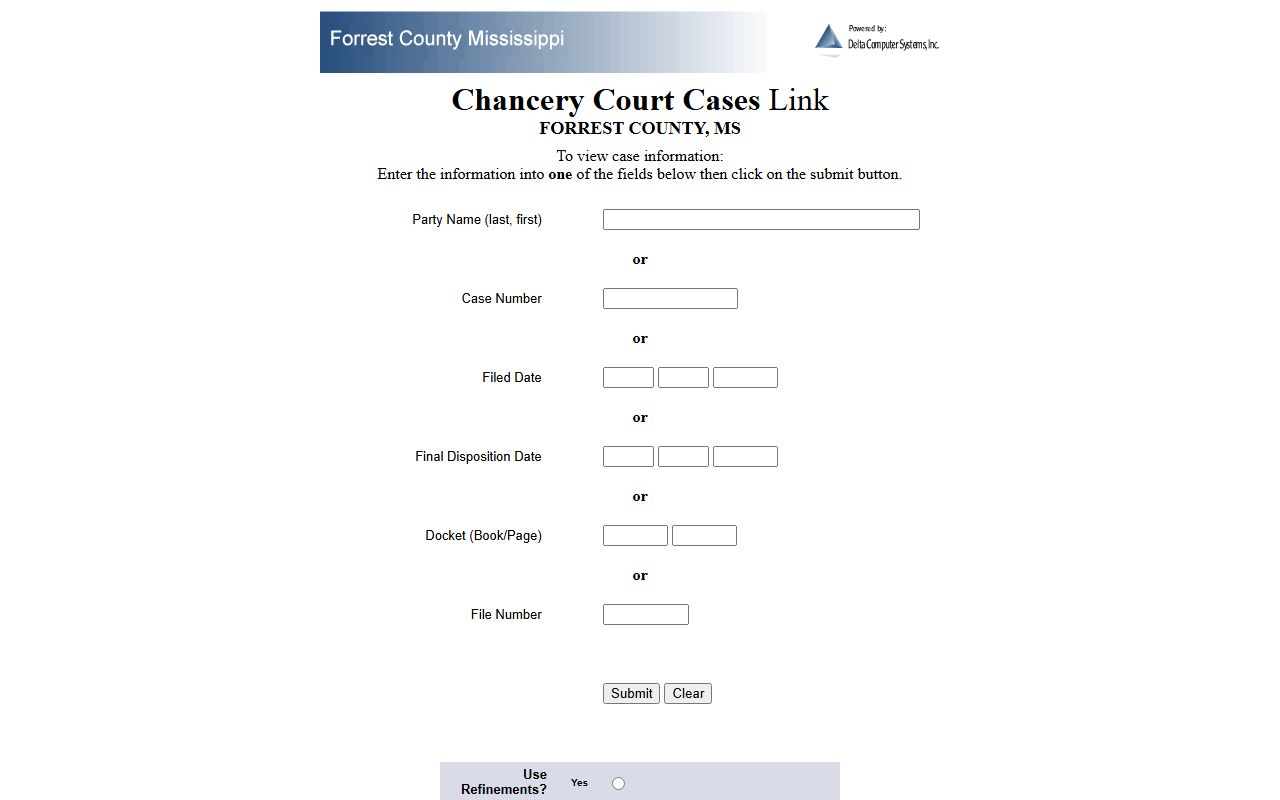
That page is the public front door to chancery dockets, where estate and guardianship cases appear once they are filed. The fields it offers are summarized here.
| Field Label | Type | Required | Notes |
|---|---|---|---|
| Party Name (last, first) | Text | Optional | Use decedent, representative, guardian, or party name. |
| Case Number | Text | Optional | If known from notices or prior filings. |
| Filed Date | Date | Optional | Useful for recent estates. |
| Final Disposition Date | Date | Optional | Useful for closed estates or guardianships. |
| Docket (Book/Page) | Text | Optional | Useful for older docket references. |
| File Number | Text | Optional | Clerk-provided reference. |
| Use Refinements? | Radio | Optional | Yes or No; refinements apply only to name searches. |
| Nature of Action | Dropdown | Optional | Helps filter estate and guardianship filings. |
Note: The online index can lag behind the courthouse file, so confirm anything important with the Chancery Clerk before you rely on it.
Forrest County Chancery Court Contacts
Probate paperwork and certified copies come from the Chancery Clerk's office on Main Street in downtown Hattiesburg. The clerk, Lance Reid, keeps the chancery files, issues process, and records docket and minute activity. District-level questions, such as which chancellor hears a setting, route through the Tenth Chancery District office. Administrators Gloria Moorer and Joy Wiley Haley help manage that district workload.
Forrest County Chancery Clerk
Lance Reid, Chancery Clerk
641 North Main Street
Hattiesburg, MS 39401
(601) 545-6041
Paul B. Johnson Chancery Building
Tenth Chancery District
Hattiesburg office
P.O. Box 1977
Hattiesburg, MS 39403
(601) 545-6079
The Tenth Chancery District site gives a fuller view of the multi-county court and its chancellors. The image below comes from the Tenth Chancery District homepage.
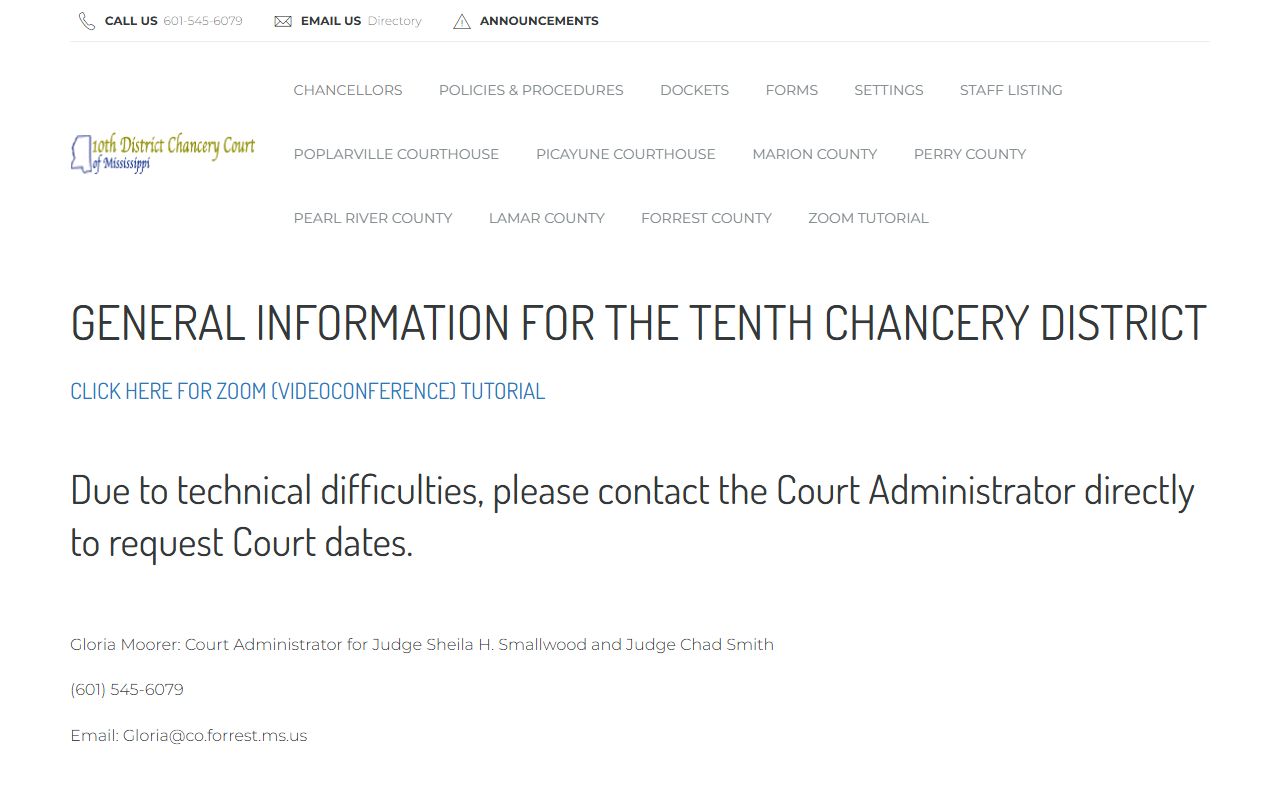
That district page ties Forrest County to its four neighboring counties and the chancellors who travel among them. Divorce cases run through the same court, and those are covered on the marriage and divorce records page.
Forrest County Probate Filing Fees
Probate filing fees were not published in the official sources reviewed for Forrest County, so the safest step is to call the Chancery Clerk before you file. The clerk receives and accounts for the filing fees that go with pleadings and appeals, and staff can quote the current amount for an estate, a guardianship, or a certified copy. The one fee that is documented is the service charge for online purchases through the Chancery portal.
| Item | Amount |
|---|---|
| Chancery online purchase service fee | 3.5%, $2.00 minimum (non-refundable) |
| Original probate application | Call to confirm |
| Letters testamentary | Call to confirm |
| Guardianship or conservatorship application | Call to confirm |
| Certified copy per page | Call to confirm |
Important: Online credit-card copies through the Chancery portal are final and non-refundable, so check that you have the right case and document before you pay.
What Forrest County Probate Records Show
A probate file builds up as a case moves forward. An estate file often opens with a petition or application and the original will, if one exists. From there it can hold the order appointing the executor or administrator, the inventory of assets, creditor notices, claims, accountings, and the final order of distribution. Letters testamentary or letters of administration prove the fiduciary's authority. Guardianship and conservatorship files look different. They tend to include the petition, support for the need, the appointment order, a bond, and annual reports or accountings.
Common items you may find in a Forrest County probate file include the following.
- Petition or application to open the estate or guardianship
- The will, if one was filed with the court
- Letters testamentary or letters of administration
- Inventory and appraisement of estate property
- Creditor notices, claims, and accountings
- Orders, waivers, and the final distribution
The portal shows index and docket entries, not full document images. To read or copy the actual pleadings and orders, ask the Chancery Clerk. Some pages may be redacted where they hold private data.
Opening an Estate and Getting Letters
Anyone settling a Forrest County death usually starts with the Chancery Clerk. First confirm the venue is correct for the decedent or ward. Then search the case link to see whether a file already exists. To open a new estate, you prepare the petition or application, the original will if there is one, death information, the names of heirs or beneficiaries, and the documents for the proposed fiduciary. The clerk takes the pleadings and fees, creates the file, issues process, and records docket and minute activity.
The chancellor then hears the required matters. That can mean probate of the will, appointment of the executor or administrator, setting a bond, and reviewing the inventory and accountings. Once the orders are entered, you return to the Chancery Clerk for certified copies of the letters and orders. A certified copy carries the clerk's seal and is the version banks, title companies, and other courts will accept. Order the copies you need before you start closing accounts or transferring property, and confirm the per-page charge when you call.
Older Probate Files in Forrest County
Not every estate is in the online index. Older Forrest County probate files may exist only in the courthouse books. For those, the Chancery Clerk can run a manual search by name, by docket book and page, or by a date range. Bring as much detail as you can, since a full name and an approximate year shorten the hunt. There is no statewide Mississippi probate database that replaces the county chancery files, so the courthouse remains the source of record.
If you are tracing family history or settling a long-dormant estate, ask the clerk how far back the indexes run and whether the volumes can be viewed in person. Land records held by the same office can fill gaps when an estate involved real property. The Chancery Clerk is the keeper of record for several county functions, and the clerk's office page explains how those duties fit together.
Restricted Probate Information
Probate is broadly public, but not every part of a chancery file is open. Guardianship and conservatorship records can carry medical, financial, and personal data that the court protects. Minor names, Social Security numbers, account numbers, and sensitive addresses may be redacted from an otherwise open file. A record can be partly public and partly withheld.
Some chancery matters are closed almost entirely. Adoption files are not ordinary public records and generally require party authority or a court order. Involuntary mental commitments and involuntary drug or alcohol matters can hold private health information and are treated as restricted. Do not assume that full documents are downloadable from the public portal. When access is unclear, the Chancery Clerk can tell you whether a docket entry is open, whether redaction applies, or whether a court order is needed first.
Note: Sealed estate, guardianship, and mental-health files stay closed even when the rest of the chancery docket is open to the public.